Arturo Sandoval at his most baddass. Guitar dude also shreds pretty good, although I don't know his name-anyone know him? Live at Montreal from 1991, a bit old but still good to listen to!
Sunday, January 29, 2012

A new CEO for RIM

As a long-time BlackBerry fan, I most definitely wish Mr Heins all the best in his mission to save the beloved BlackBerry from being either bought by another handset maker or simply dissolved the way of Kodak.
Certainly, of all people, Thorsten Heins does have the background and competence for the job. Before working for RIM, Mr Heins was responsible for mobile products development at Siemens. He therefore has all the rigorous management experience it takes to fix RIM's main weakness, namely its ability to execute on new products and strategies. So far RIM have done the right thing to acquire QNX and to adopt this excellent OS for their mobiles; now they need to deliver the phones to the (impatient) public, all without bugs and disappointments. I believe Mr Heins can do this.
As a long-time BlackBerry user, I would like to see RIM deliver the following improvements and new services over the course of this year:
1. Finally deliver BlackBerry 10 OS. Like, now!!!
2. I would like a more sturdy, better-looking handset. My next BlackBerry should look and feel better than an Apple crap-phone. I unfortunately dropped my Bold a couple of times and now the speaker is not working very well. This shouldn't happen. Make me a unibody handset that's indestructible!
3. Reduce the number of phone models but design them better and update them more frequently.
4. I want my @bbmail.com email address!! RIM have these giant servers, they have no excuse not to provide a decent email service to their customers, one that would work more reliably and more securely than Apple's .me or Google's gmail. Not to mention that RIM are based in Canada and therefore not subjected to the US of A's paranoid, email-snooping laws.
5. Give me a music streaming service. Forget selling music tracks, as in iTunes. Today the name of the game is the Cloud: with their email forwarding servers RIM are in the best position to beat Apple at providing streaming media to their customers.
6. Ditto with video: some people do like to watch movies on their phone while commuting, as well as the news.
7. I demand, I want the best built-in apps for real-time stock charting and financial news on my BlackBerry. This is something that a lot of BlackBerry's users who work in finance would love and it could be RIM's killer app. A strategic alliance with either Bloomberg or Reuters or both would be most relevant to that end. Pushing news updates and stock price alerts to financial investors' mobiles would be most useful.
RIP Etta James
This past Friday, legendary blues singer Etta James passed away at the age of 73. It simply ruined my weekend to read this in the papers-until I listened to the above track.
Monday, January 23, 2012

Thursday, January 19, 2012
Dinner für einz
Thanks to German TV channel ARD for this hilarious parody of the classic British comedy sketch 'Dinner for one,' which is apparently very popular in Germany.
Clic clac!

It is needless to say an irony, as many journalists have rightly pointed out, that the company that had first invented the digital imaging sensor more than thirty-five years ago, would become the victim of its own creation. Ever since the advent of the digital camera, nobody ever uses Kodak film anymore.
Today Kodak does make digital cameras but they are simply not earning much money from them, in a very competitive market with constantly shrinking margins. Simply put, the Taiwanese and Japanese can make better digital cameras for cheaper anyway. And of course, the same goes with small inkjet photo printers. These will never bring Kodak back to its former profitability.
So what's Kodak to do now? for one, they ought to start with an honest look at why it is they failed to recognize in advance that they would end up in this very situation and, more importantly, why they failed to act when they finally did realize the problem they were running into. In this respect, they should probably follow The Economist and compare their fate to the evolution during the same period of time of their main Japanese competitor, Fujifilm. Unlike their American rival, Fujifilm have successfully managed to engineer a transition from producing photographic film to diversifying into other areas of chemistry and electronics.
At this point it is unfortunately doubtful that there is much that Kodak can do to avoid falling into oblivion and being broken up and sold in pieces. Or at the very least, the company that will emerge from the bankruptcy proceeding will be but a pale image of the original Kodak.
Saturday, January 14, 2012
GPS fail

3-year-old girl stares down lion
"But what is the lion trying to tell me??" I wonder... no parent suffered a heart attack in the making of this film.
Friday, January 13, 2012
Thursday, January 12, 2012
Interview with ARM's Ian Drew

Lenovo show off first Intel smartphone

Unfortunately for Intel, they are releasing into the wild a one-core chip, which was the standard about two years ago, while the Nvidia's and Qualcomm's of the world are now all announcing upcoming smartphones with their latest quad-core processors.
This said, aside from the fact that Intel's x86 architecture is an awful mess that is totally not suited for mobile computing-or any kind of computing for that matter-the big hurdle that Intel salespeople will have to overcome will be to convince the millions of mobile developers to adapt and recompile their apps to work on Intel. This might have been realistically attainable two years ago but now that there are literally hundreds of thousands of apps that have been written for the ARM architecture on both the Google Android and Apple iOS platforms, Intel will have their work cut out for them. And since software emulation is bound to be a drag on power consumption, it looks to me like Intel will almost certainly fail in their latest mobile effort.
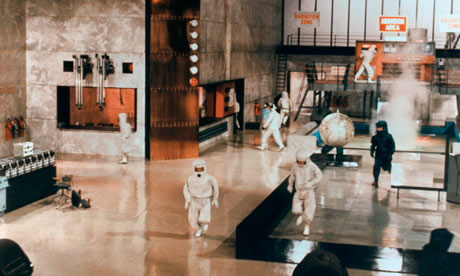
Bond 'giving nuclear bad image'
Wednesday, January 11, 2012
Building hubris

Tuesday, January 10, 2012
Apple coughs $5m for multitouch patents

Monday, January 9, 2012
Layer by layer

Mathematicians Solve Minimum Sudoku Problem
 This weekend it was announced that the so-called Sudoku problem had finally been solved. This was to prove that there exists no Sudoku grid with only 16 starting clues that would admit a unique solution. As reported in Technology Review, Gary McGuire and colleagues from University College Dublin have cracked the problem thanks to the magic of brute force: they used a really big computer for a whole year to solve all the possible grids with 16 starting clues-more than five billion of them-and check that indeed, none of them had a unique solution. This took more than seven million processor core-hours of computation. Now we're all waiting for a smart proof using only paper and pencil...
Sunday, January 8, 2012
"Tectonic Shifts" in Employment
This is an interesting idea, which I have been observing for quite some time simply by following the quick improvements being made in engineering fields such as robotics and computer vision. We now have self-driving robotic cars that might some day replace all taxi drivers and delivery people. We also have automated subway trains, which no longer need a driver in front. All of these are situations where technology is simply making work redundant. Another example that is currently becoming very relevant is that of fruit and vegetable picking robots, which in the near future will be replacing millions of Mexican workers on agricultural fields throughout California.
Yet it seems to me the authors and economists cited in the article do not go far enough: a logical consequence of this phenomenon is that at some point in the not-so-distant future, all of our basic needs such as food and housing will be provided to us by machines, essentially without human intervention.
This is the point where people will simply no longer need to work in order to survive. Then the question will be, how are all the goods produced by machines going to be distributed to the people and in exchange for what? will money become irrelevant in some way?
North Korean labor camps
The latest documentary by Vice's Shane Smith, on the North Korean labor camps in Siberia. To summarize, let me just say how lucky we are to not be North Koreans...
Subscribe to:
Comments (Atom)