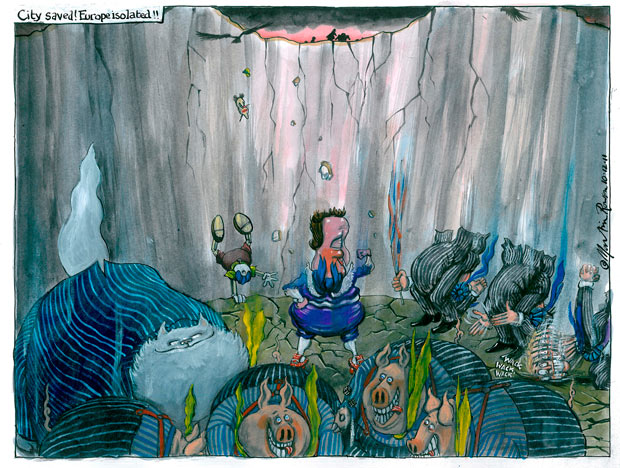
 As a Frenchman living in the UK for the past eight years I now have a unique perspective on the ongoing struggle that Great Britain and its prime minister, David Cameron, are facing regarding the euro crisis. In many ways I have sympathy for Mr Cameron, who just tried to veto the latest EU treaty change to impose fiscal austerity measures as well as a Tobin-style tax on financial transactions across Europe. Obviously the eurozone crisis remains a gigantic mess, which British politicians had correctly predicted over ten years ago back when the euro was first introduced. None of this of course is Britain's fault and yet it is starting to exact a heavy toll on the British economy.
That said, it is hard to see how Mr Cameron's go-it-alone approach will really either help the City of London and its financial institutions or even spare Britain the consequences of a full-blown sovereign debt crisis on the continent.
For one thing, trading in euros now accounts for just under half of the business being conducted within the City of London. The fact that the British government is flatly refusing to submit the British banks to the new financial transaction tax will now be giving an excuse for France and Germany to attempt to claw back all this euro financial business to Paris and Frankfurt. If Britain does not want to play along with the eurozone countries and the EU as a whole, then it is fair game to compete with by all means, including by restricting the UK's access to the common market. Although this may not be an immediate threat as long as Britain remains a member of the larger EU club, this is bound to become a growing risk as London drifts away from the continent politically.
Then of course there is the problem of the eurozone debt crisis and the effect that a possible default of one or more of its members would have on the British financial system and its overall economy. Because trading with continental Europe accounts for roughly 40% of Britain's GDP, this is bound to be huge. The exact consequences on Britain will of course depend wildly on how the crisis will be dealt with, whether through a devaluation of the euro or simply haircuts that will be imposed on Spanish and Italian bondholders. For instance if the euro were to be devalued, this would have an immediate impact on the competitiveness of British exports to the rest of the EU market. This is why I would argue the British government ought to stay in the political game of the EU for as long as it can, in order to influence the outcome and the manner in which the crisis is being handled.
For both of these reasons, clearly Mr Cameron's approach may end up severely harming Britain's interests as opposed to defending them with the fierce bite of a proverbial British bulldog. (Cartoon by Martin Rowson from The Guardian).

No comments:
Post a Comment